What to Expect When Commissioning a Bronze Sculpture
Frequently
Asked
Questions
-
Custom bronze sculptures can range from tens of thousands to hundreds of thousands of dollars, depending on the sculpture's size, number of figures, complexity, level of detail, and installation requirements. Each commission is priced individually, and Joel provides a fixed quote after understanding the project.
That said, Joel aims for fairness in pricing, and this is where conversation is the most helpful. Joel has negotiated with many clients to arrive at appropriate designs that fit the client’s budget.
-
It is a good idea to plan for at least 6 months in advance for smaller sculptures and at least a year for larger monuments.
Each project has its own difficulties, so a more specific timeline will be provided for each project. These timelines are simply a good place to start when planning a custom bronze sculpture commission.
-
Joel can often handle the delivery, but not always. Depending on location and availability, Joel will either personally deliver a piece, or work with you to have it shipped.
On occasion, the client will come pick it up themselves, usually if they are local or happen to be traveling. The trade-off here is that the client is responsible for any site-specific preparation for the installation of larger bronze sculptures.
If a sculpture is to be installed outdoors and on a public site, it is commonly required to anchor the sculpture into a concrete or stone base. Joel can offer consultation on what is properly needed to support a sculpture and how to install it, but does not cover the cost or do this work personally.
For larger outdoor or public bronze sculpture commissions, installation requirements should be discussed early in the process so the sculpture can be designed and prepared appropriately for its final location.
-
You are welcome to be as involved as you would like, within reason.
The beginning stages always require the client’s input, and the more information the client can provide, the better. There will usually be less input, however, during the sculpting and production stages.
When sculpting begins, this is when the artist needs “space to create,” so patience is greatly appreciated. Periodic updates that include photos will be shared.
After sculpting is finished, the client will sign off with a final “OK” before the piece enters production. Any changes must be made before production begins, and the client will always be consulted before moving forward.
-
Due to the scale of work and cost that goes into bronze sculpture, it is important to protect both the client and the artist as best as possible.
Financially speaking, this is typically done by splitting the total cost into thirds, with an up-front design fee of $2,000 for sketches. The initial design fee will go toward the final cost and is non-refundable, even if the project does not move past design.
Once the design is agreed upon, the first third payment is due before sculpting begins.
The second installment is paid after the client signs off on the finished sculpture and before production begins.
The final payment is due before shipment or installation.
an Overview…
of the Bronze Sculpture Commission Process
Commissioning a custom bronze sculpture is a collaborative process, and choosing the right sculptor is one of the most important decisions you will make. Joel specializes in creating custom bronze sculptures that bring a client’s vision to life through careful design, exceptional skill as a sculptor, and a deep knowledge of the production process known as Lost-Wax Casting. From the first sketch to the finished sculpture, Joel works closely with each client to understand the subject, story, and purpose behind the piece while bringing his experience as a sculptor to every stage of the process.
Every commission is unique, but the process follows a series of carefully considered steps. The following overview explains what you can expect when working with Joel to create a custom bronze sculpture, from the initial concept through casting, finishing, and final installation.
Sketches
Every sculpture begins with an idea, but that initial idea is not always as clear as we would hope. An idea can go through several iterations before a final design is chosen. Since this can be an extensive amount of work up front, a small sculpted sketch, known as a “pinch model,” is often done first to help visualize the initial composition.
This is not intended to be a finished sculpture yet, so the pinch model is left very “rough” and serves to work out the design only, ignoring details for the time being. Think of this as a quickly hand-drawn road map that leaves out all the stops along the way.
Research
To ensure that the client’s desired quality is met, there will be a constant dialogue throughout the entire process, but it is usually heaviest during these early stages. Here, research of appearance, historical articles and items, and especially the “spirit” the client wishes to capture are the top priority.
These reference materials are vital for an artist’s ability to portray a bronze sculpture accurately. They can be gathered both by the artist and provided by the client, consisting of photo references and physical objects. Stories are always welcome too and will be interpreted by the artist to help inform the final sculpture.
Modeling and Sculpting
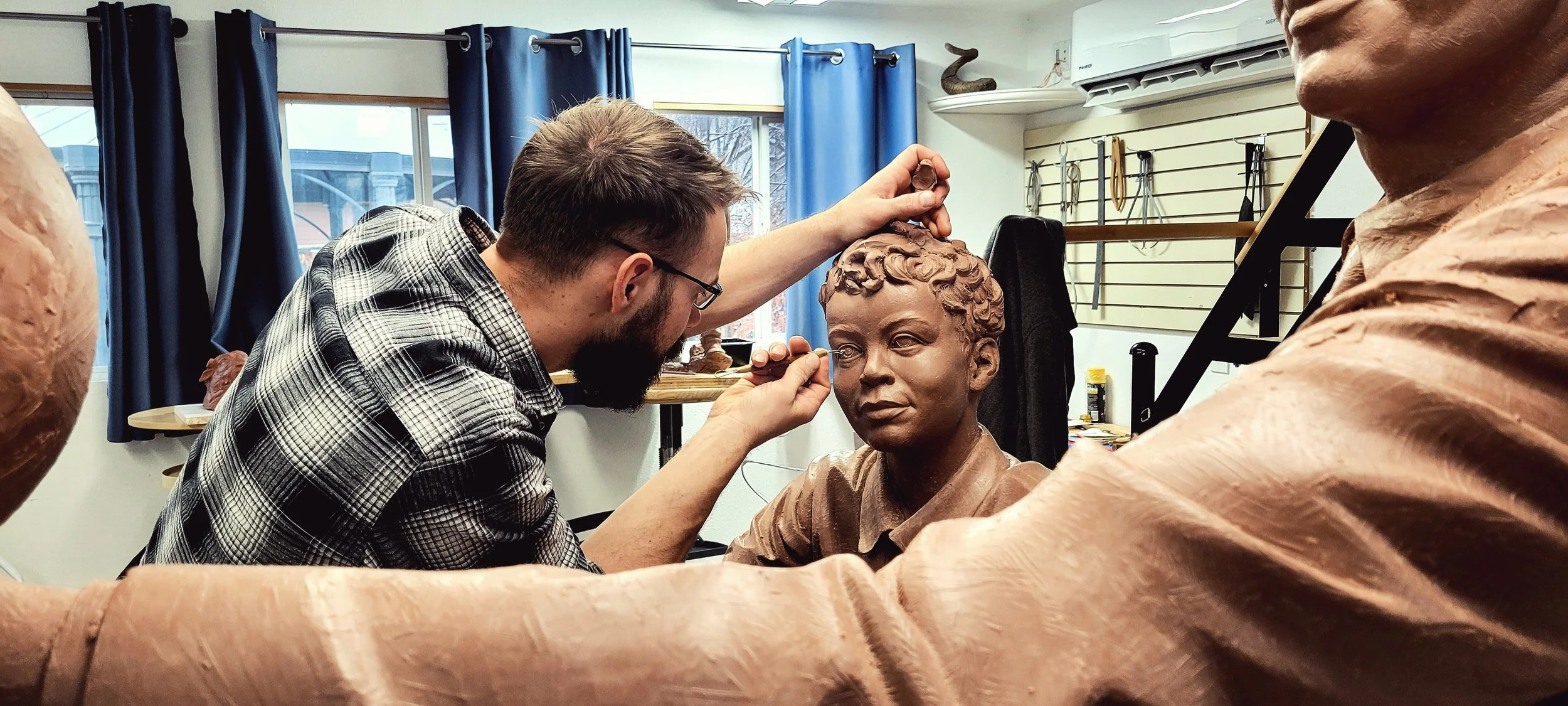
Once the idea is agreed upon, we move into the modeling stage, and this is where the sculpture comes to life. Early stages involve capturing the initial gesture, or flow, with an aluminum armature that can be understood as the “skeleton” of the sculpture.
From there, it is a matter of building up forms while paying close attention to anatomy and movement. Clothing designs are always considered at the very beginning, but it usually isn’t until later that they are applied.
These stages can take significant time, and close communication is necessary for finalizing the sculpture. The client will always give a final “OK” at the end of modeling because after this step it is impossible to change things without significant additional work and expense.
Production: The following production stages are the steps required to transform a clay sculpture into bronze. This is known as “lost-wax” casting and involves multiple steps including molding, wax casting, shell, bronze casting, welding & finishing, and finally patina.
Molding
We begin by making a two-part silicone and plaster mold over the clay sculpture. The silicone is a flexible layer that captures the details and rests inside a rigid shell of plaster that holds the shape.
Another important detail that often surprises people is that almost every sculpture is cut into pieces. These parts are more manageable and ensure that the mold will not “lock” onto the pieces.
After molding is complete, all pieces are removed from the clay model, leaving a hollow mold that is essentially a negative copy of the sculpture similar to the negatives of film photography.
Wax Casting
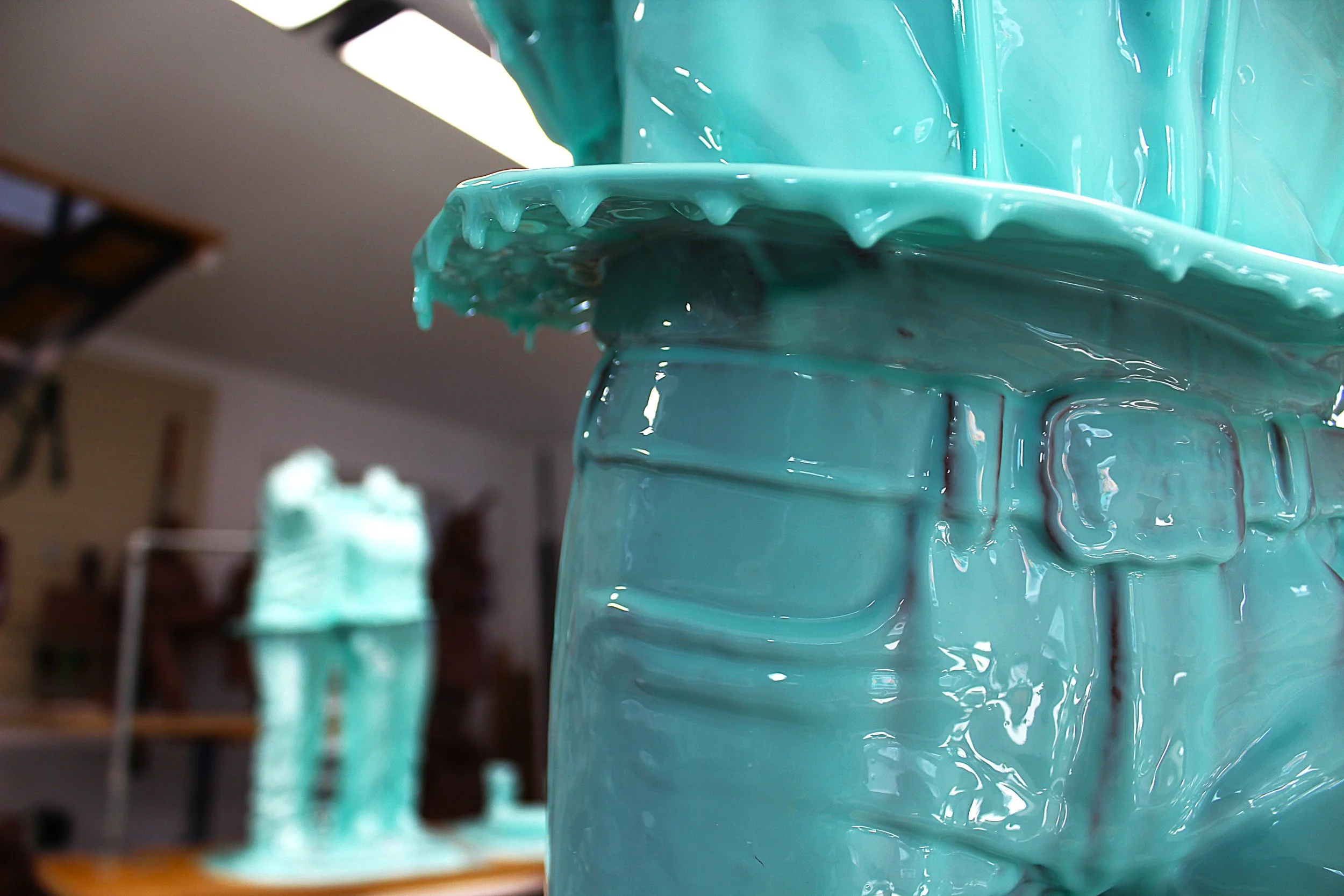
Melted wax is then poured into the empty molds, rolled around to coat every surface, and then dumped back out. This will be repeated several times because most bronze sculptures are hollow, with the exception of very small pieces, and this layering helps us achieve a correct thickness.
The ideal thickness is about 3/16 inch and ensures a stable casting without becoming excessively heavy or costly.
Once the wax has cooled, it is removed from the mold and we are left with a wax copy of the sculpture. The wax is checked for imperfections that are fixed before it is taken to a foundry for casting.
Shell and Bronze Casting
At the foundry, the wax will be prepped for casting by adding wax structures called “sprues” that act as passageways to allow easier bronze flow during casting. The sprued wax copy will next be repeatedly dipped in layers of a ceramic slurry mixture that will dry to create a ceramic shell around the wax.
Think of this as a second molding, except this one is heat resistant.
Next, the shell is placed upside down in an oven that will fire the ceramic shell, similar to pottery, while simultaneously melting out the wax. This is where the term “lost wax” comes from, and we are left once again with a negative copy.
Finally, molten bronze is poured into the shell, filling all the space the wax originally held.
Welding and Finishing
After the cast bronze has cooled, it is time to break the shell off, revealing the raw bronze pieces. Because the sculpture has to be cut into pieces before molding begins, each piece must now be reassembled.
For this, we use TIG welding to put the sculpture back together in its original form. Since we don’t want our art to appear as though it has been welded, there is a substantial amount of grinding, polishing, and texturing that goes into cleaning the welds.
At this point, the sculpture is nearly complete.
Patina
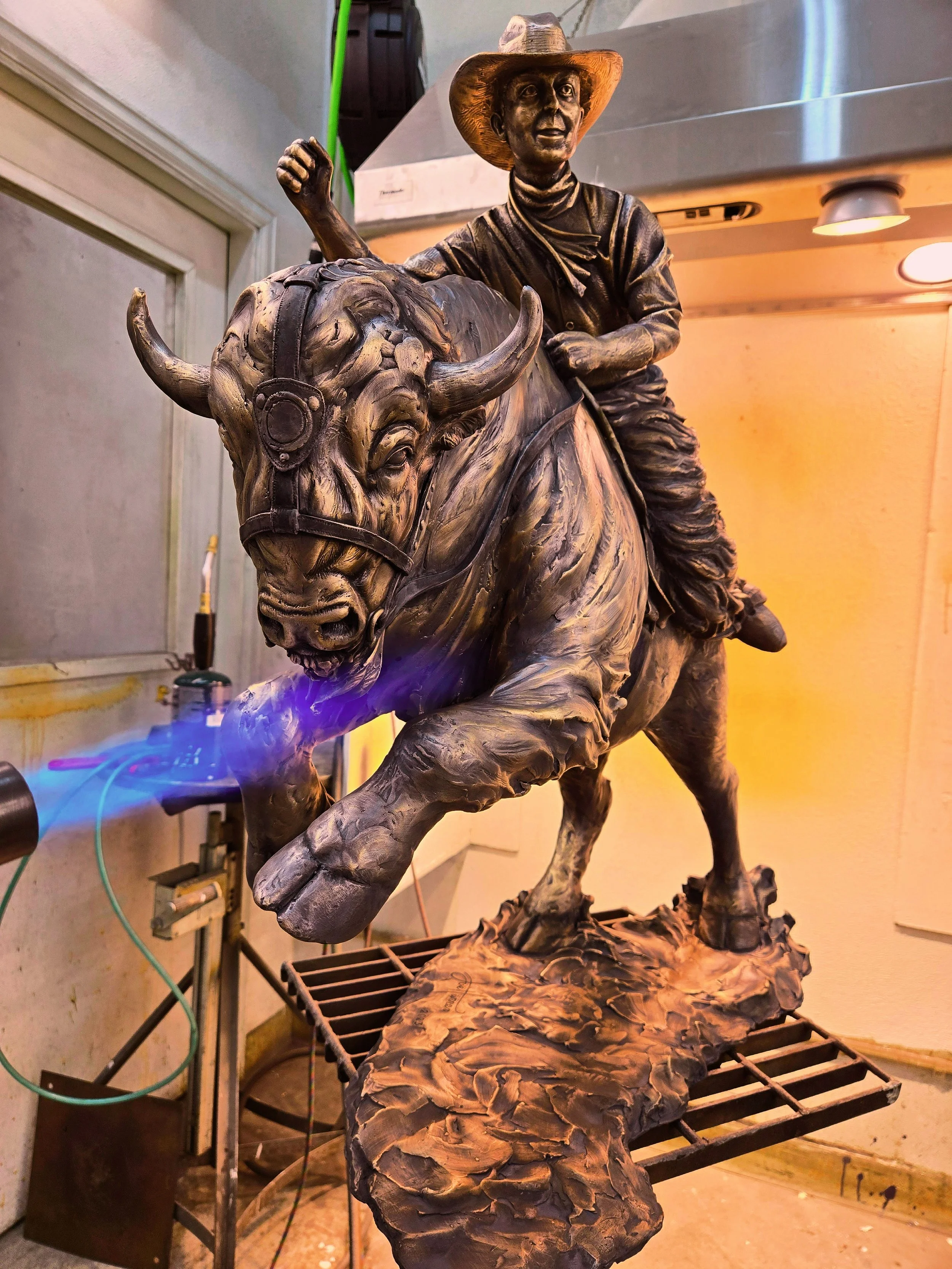
Patina is the process of using chemical reactions to color the bronze, create a protective layer, and enhance the visibility and aesthetic of the bronze sculpture. Patina is often considered its own artistic craft that should complement the sculpture and complete its beauty.
There are many methods of patina, some are more traditional while others may be considered modern. The client will work closely with the artist to decide which bronze patina will best suit their sculpture.
Finally, a protective coating of lacquer followed by a coat of paste wax is applied and the sculpture is now complete.
Commission a Custom Bronze Sculpture
If you are considering commissioning a bronze sculpture, the best place to begin is with a conversation about your idea. The subject, intended size, location, budget, and overall vision will help determine the appropriate approach for your project.
Every commission is unique, and the process is designed to bring the client’s vision and the artist’s experience together to create a lasting bronze sculpture.
Beauty in Precision, with Every Step
The Clay Model
Every commission begins with a clay model that serves as the foundation of the piece.
Molding
The clay model sculpture undergoes a two-part silicone and plaster molding process.
Wax & Bronze Casting
A wax copy is first poured from the mold, followed by bronze pouring.
Welding & Patina
The bronze pieces are welded together and finished with a patina.